
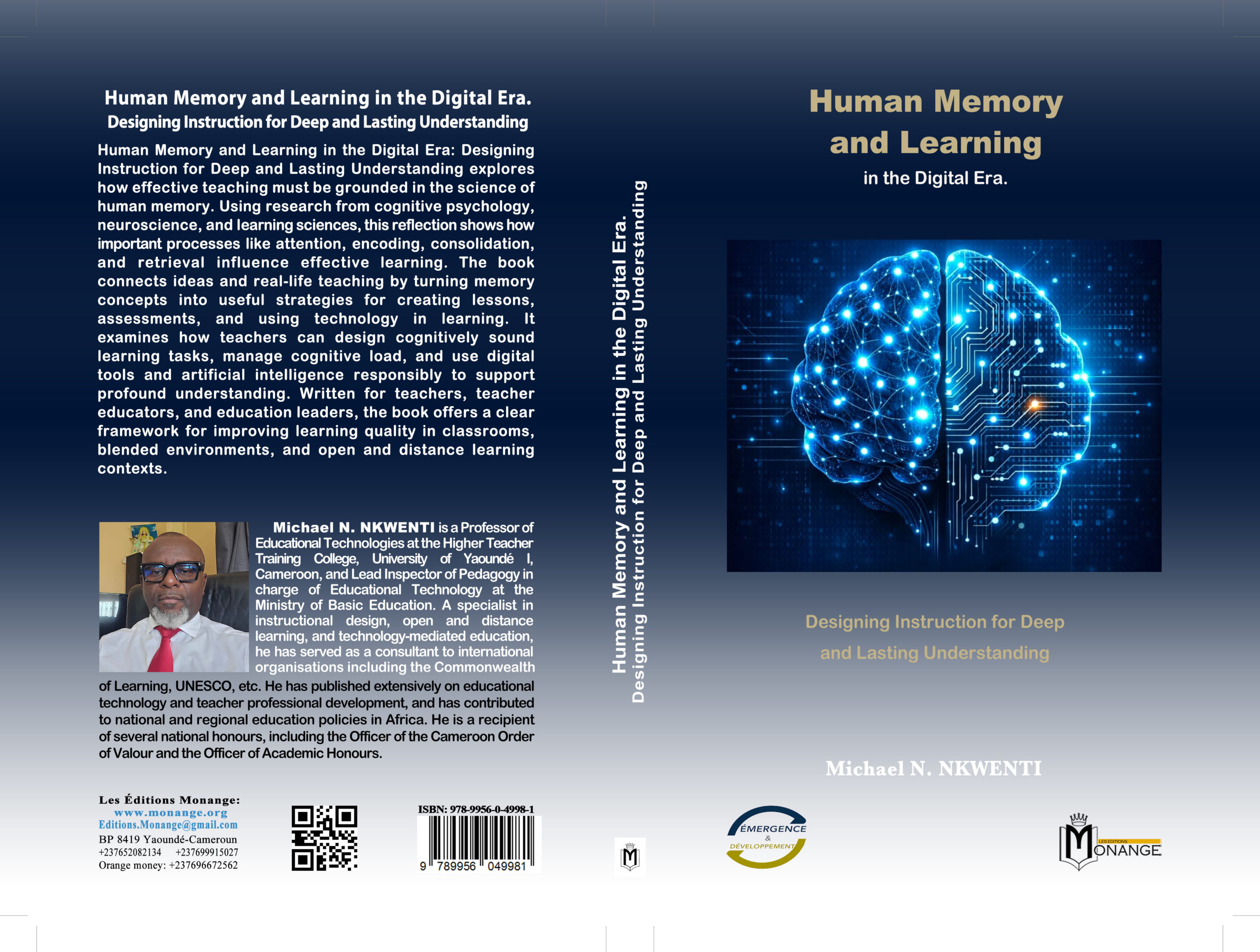
Michael N. NKWENTI, Human Memory and Learning in the Digital Era, Yaoundé, Monange, 2026, 280 pages.
Sommaire
Part I: Foundations of Human Memory and Learning
Chapter 1: Introduction to Human Memory and Learning
1.1. Human Memory and the Learning Process
1.1.1. Memory as the Foundation of Learning
1.1.2. Core Memory Processes in Learning
1.1.3. Memory Systems and the Flow of Information
1.1.3. Meaningful Learning and Prior Knowledge
1.1.4. Memory, Learning, and Educational Outcomes
1.2. Types of Memory in Learning: A Conceptual Overview
1.2.2. Short-Term (Working) Memory
1.2.4. Interrelationship of Memory Systems in Learning
1.3. Learning and Memorisation
1.3.1. Memorisation as a Cognitive Process
1.3.2. Learning as Meaningful and Durable Change
1.3.3. Key Differences Between Learning and Memorisation
1.3.4. The Relationship Between Memorisation and Learning
1.3.5. Educational Significance of the Distinction
1.4. Memory and Instruction: A Conceptual Relationship
1.4.1. Memory as the Cognitive Medium of Instruction
1.4.2. Instructional Constraints Imposed by Working Memory
1.4.3. Long-Term Memory, Consolidation, and Retrieval
1.5. Conceptual Implications for Teaching
1.5.1. Memory-Informed Teaching
1.5.2. Learning as an Active, Meaning-Making Process
1.5.3. Cognitive Capacity Limits and Instructional Coherence
1.5.4. The Central Role of Prior Knowledge in Learning
1.5.5. Retrieval, Retention, and Transfer of Learning
1.5.6. Memory Awareness and the Professional Role of the Teacher
Chapter 2: Structure, Types, and Function of Human Memory
2.1. Overview of the Three Memory Systems
2.2. Sensory Memory: Initial Registration of Information
2.2.1. Nature and Temporal Characteristics of Sensory Memory
2.2.2. Iconic and Echoic Memory as Modality-Specific Registers
2.2.3. Attention as the Critical Selection Mechanism
2.2.4. Functional Role in the Learning Process
2.2.5. Educational and Instructional Significance (Conceptual)
2.3. Working Memory: A Capacity-Limited Processing System
2.3.1. Capacity Limitation as a Structural Constraint
2.3.2. Processing Load and Element Interactivity
2.3.3. Temporal Limits and Information Decay
2.3.4. Prior Knowledge Expands Functional Capacity
2.3.5. Implications for Learning and Instruction
2.4. Long-Term Memory: Durable Storage of Knowledge
2.4.1. Structural Characteristics of Long-Term Memory
2.4.2. Memory Consolidation and Durability
2.4.3. Organisation of Knowledge in Long-Term Memory: Schemas
2.4.4. Types of Knowledge Stored in Long-Term Memory
2.4.5. Retrieval as a Durability Mechanism
2.4.6. Implications of Long-Term Memory Durability
2.5. Integration of Memory Systems in Learning
2.5.1. Coordinated Information Flow Across Memory Systems
2.5.2. Bidirectional Interaction Between Working Memory and Long-Term Memory
2.5.3. Encoding, Consolidation, and Retrieval as Integrative Memory Processes
2.5.4. Educational Implications of Integrated Memory Functioning
2.6. Factors Influencing Memory Functioning
2.6.1. Attention and Cognitive Engagement
2.6.2. Depth of Processing and Significance
2.6.3. Prior Knowledge and Schema Availability
2.6.4. Cognitive Load and Task Complexity
2.6.5. Emotional State and Motivation
2.6.6. Practice, Retrieval, and Feedback
2.6.8. Memory Functioning as a Dynamic Interaction
Chapter 3: How the Human Brain Learns
3.1. How learners receive, process, and retain new information
3.1.1. Stage one: Taking in information (attention and perception)
3.1.2. Stage two: Processing information (working memory and encoding)
3.1.3. Stage three: Retaining information (storage in long-term memory)
3.1.4. Stage four: Retrieving information (recall and use)
3.1.5. Factors that influence learning and retention
3.1.6. Educational Implications
3.2. The impact of attention, perception, and interest on learning
3.2.1. The role of attention in learning
3.2.2. The role of perception in learning
3.2.3. The role of interest in learning
3.2.4. The combined effect on learning
3.3. How the brain forms new neural connections during learning?
3.3.2. How learning forms new neural connections
3.3.3. The Role of the Hippocampus and Prefrontal Cortex
3.3.4. Factors that influence neural connectivity in learning
3.4.5. Educational implications
3.4. How repetition and practice strengthen memory and understanding
3.4.1. Repetition in memory formation
3.4.2. The role of practice in deepening understanding
3.4.3. The spacing effect as a pathway to repetition over time
3.4.4. Distributed and varied practice
3.4.5. Procedural learning and habit formation
3.4.6. Classroom applications of repetition and practice
Chapter 4: Memory Processes in Learning
4.1. Encoding, Storage, and Retrieval in Simple Terms
4.1.1. Encoding: How the Brain Takes in Information
4.1.2. Storage: How the Brain Maintains Information Over Time
4.1.4. How Encoding, Storage, and Retrieval Work Together
4.2. How Encoding Happens Through Text, Audio, Video, and Interactive Tools
4.2.4. Encoding Through Interactive Tools
4.3. How Rehearsal, Association, and Organisation Support Long-Term Storage
4.3.1. Rehearsal: Strengthening Memory Through Repetition
4.3.2. Association: Linking New Information to What is Already Known
4.3.3. Organisation: Structuring Information to Facilitate Encoding and Retrieval
4.3.4. The Combined Power of Rehearsal, Association, and Organisation
4.4. The Role of Multimedia in Enhancing Long-Term Memory
4.4.1. Understanding Multimedia and Long-Term Memory
4.4.2. The Cognitive Theory of Multimedia Learning
4.4.3. Supporting Encoding with the Use of Multimedia
4.4.4. Multimedia and Long-Term Storage
4.4.5. Multimedia and Retrieval of Information
4.4.6. Best Practices for Using Multimedia to Enhance Long-Term Memory
4.5. How Cues and Context Influence Memory Recall
4.5.2. The Role of Context in Memory Recall
4.5.3. Interaction Between Cues, Context, and Memory Systems
4.5.4. Strategies to Enhance Memory Recall Using Cues and Context
4.6. Using Chunking and Scaffolding to Improve Digital Content Retention
4.6.1. Chunking and Its Role in Retention
4.6.3. Combining Chunking and Scaffolding for Digital Learning
4.6.4. Best Practices for Designing Chunked and Scaffolded Digital Content
4.7. Common Reasons Why Learners Forget and How to Overcome Them
4.7.1. Lack of Meaningful Encoding
4.7.2. Insufficient Rehearsal and Practice
4.7.3. Interference from Similar Information
4.7.6. Low Motivation or Emotional Engagement
Chapter 5: Strategies for Retention and Long-Term Learning
5.1.1. Using Basic Memory-Enhancing Strategies
5.1.2. Mnemonics: Enhancing Memory Through Association
5.1.3. Visualisation: Strengthening Memory Through Mental Imagery
5.1.4. Chunking: Organising Information for Cognitive Efficiency
5.1.5. Integrating the Strategies for Maximum Effect
5.2. The Benefits of Spaced Repetition and Retrieval Practice
5.2.1. Spaced Repetition: Strengthening Memory Over Time
5.2.2. Retrieval Practice: Learning by Actively Recalling Information
5.2.3. Combining Spaced Repetition and Retrieval Practice
5.3. The Use of Storytelling, Concept Mapping, and Analogies in Memory Retention
5.3.1. Storytelling: Leveraging Narrative to Enhance Memory
5.3.2. Concept Mapping: Structuring Knowledge for Visual Recal
5.3.3. Analogies: Connecting the New to the Known
5.3.4. Combined Effect on Memory Retention
5.4. How to Apply Memory-Enhancing Techniques in Real Teaching Contexts
5.4.1. Applying Storytelling to Teaching
5.4.2. Using Concept Mapping in Science and Social Studies
5.4.3. Introducing Analogies in STEM Subjects
5.4.4. Teaching Vocabulary with Mnemonics and visualisation
5.4.5. Implementing Chunking in Content Delivery
5.4.6. Enhancing Retention through Spaced Repetition
5.4.7. Embedding Retrieval Practice in Daily Instruction
5.4.8. Combining Strategies in a Multimodal Lesson
5.5. Enhancing Learner Retention with Digital Technologies
5.5.1. Spaced Repetition Tools
5.5.2. Retrieval Practice Platforms
5.5.3. Multimedia Learning Tools
5.5.4. Concept Mapping and Note-Taking Tools
5.5.5. Gamification and Adaptive Learning Systems
5.5.6. Integration of Learning Analytics
5.5.7. Collaborative and Reflective Digital Tools
5.5.8. Virtual and Augmented Reality Tools
Part III: Memory and the Three Domains of Learning
Chapter 6: Designing Meaningful Learning Tasks in the Cognitive Domain
6.1. The Cognitive Domain and its Levels
6.1.1. Definition of the Cognitive Domain
6.1.2. Bloom’s Taxonomy: Original and Revised Framework
6.1.3. The Six Levels of the Revised Cognitive Domain
6.1.4. Significance of the Cognitive Domain in Teaching and Learning
6.2. The Difference Between Lower-Order and Higher-Order Thinking Skills
6.2.1. Definition of Lower-Order and Higher-Order Thinking Skills
6.2.2. Key Differences Between LOTS and HOTS
6.2.3. Educational Significance of the Distinction
6.2.4. Practical Examples in the Classroom
6.2.5. Progression from LOTS to HOTS
6.3. Learning Tasks that Promote Analysis, Synthesis, and Evaluation
6.3.1. Tasks that Promote Analysis
6.3.2. Tasks that Promote Creating
6.3.3. Tasks that Promote Evaluation
6.3.4. Cross-Curricular Projects Incorporating All Three Skills
6.4. Embedding Memory Aids in Cognitive Learning Tasks
6.4.1. Understanding Memory Aids in Learning
6.4.2. Embedding Memory Aids at Different Cognitive Levels
6.4.3. Cross-Curricular Examples of Embedded Memory Aids
6.4.4. Digital Integration of Memory Aids
6.4.5. Benefits of Embedding Memory Aids in Cognitive Learning Tasks
6.5. Using Digital Learning Technologies to Design Meaningful Cognitive Learning Tasks
6.5.1. Understanding Meaningful Cognitive Learning Task
6.5.2. Mapping Digital Tools to Bloom’s Cognitive Levels
6.5.3. Designing Cognitive Learning Tasks with Digital Technologies
6.5.4. Designing a Cognitive Task in Environmental Science
6.5.5. Benefits of Using Digital Tools for Cognitive Tasks
Chapter 7: Designing Meaningful Learning Tasks in the Affective Domain
7.1. The Affective Domain and its Importance in Learner Motivation and Values
7.1.1. Definition of the Affective Domain
7.1.2. Taxonomy of the Affective Domain
7.1.3. The importance of the Affective Domain in Learner Motivation and Values
7.1.4. Instructional Implications for Educators
7.2. Levels of Affective Learning
7.2.1. Taxonomies and Examples of Affective Learning
7.2.2. Summary of Affective Domain Levels
7.2.3. Educational Implications
7.3. Designing Tasks that Promote Empathy, Respect, and Emotional Engagement
7.3.1. Tasks that Promote Empathy
7.3.2. Tasks that Promote Respect
7.3.3. Tasks that Promote Emotional Engagement
7.3.4. Cross-Curricular Task Examples
7.4. How Emotional Experiences Improve Long-Term Memory
7.4.1. The Science Behind Emotion and Memory
7.4.2. Emotional Experiences and Educational Memory
7.4.3. Emotionally Charged Events and the “Flashbulb Memory” Effect
7.4.4. Balance Between Emotion and Cognitive Load
7.4.5. Ways to Use Emotion in the Classroom to Help Memory
7.5. Using Digital Learning Technologies to Design Meaningful Affective Domain Learning Tasks
7.5.1. Understanding the Affective Domain in Digital Contexts
7.5.2. Digital Technologies and Affective Learning Tasks
7.5.3. Aligning Technology with Affective Domain Levels
7.5.4. Best Practices for Designing Affective Digital Tasks
Chapter 8: Designing Meaningful Learning Tasks in the Psychomotor Domain
8.1. The Psychomotor Domain and its Role in Skill Development
8.1.1. Definition of the Psychomotor Domain
8.1.2. Taxonomies of the Psychomotor Domain
8.1.3. Role of the Psychomotor Domain in Skill Development
8.1.4. Instructional Strategies for Developing Psychomotor Skills
8.1.5. Assessment in the Psychomotor Domain
8.2. Levels of Psychomotor Skills
8.2.1. Dave’s Five Levels of Psychomotor Skills
8.2.2. Summary of Dave’s Psychomotor Skill Levels
8.3. Tasks for Hands-On and Performance-Based Learning
8.3.1. Characteristics of Performance-Based Learning Tasks
8.3.2. Hands-On and Performance-Based Learning Tasks by Discipline
8.3.3. Benefits of Hands-On and Performance-Based Learning
8.4. How Repetition and Feedback Enhance Psychomotor Memory
8.4.1. Understanding Psychomotor Memory
8.4.2. Role of Repetition in Enhancing Psychomotor Memory
8.4.3. Role of feedback in enhancing psychomotor memory
8.4.4. Interaction between repetition and feedback
8.4.5. Practical Applications in Education
8.4.6. Benefits of Repetition and Feedback in Psychomotor Learning
8.5.1. Role of digital technologies in psychomotor learning
8.5.2. Digital Tools for Psychomotor Skill Development
8.5.3. Designing Psychomotor Tasks Using Digital Technologies
8.5.4. Sample Digital Psychomotor Learning Tasks Across Fields
Part IV: Assessment, Feedback, and Memory Consolidation
Chapter 9: Assessing and Reinforcing Learning Through Memory
9.1. Assessment Methods that Promote Retrieval and Deep Learning
9.1.1. Retrieval-Based Assessments (The Testing Effect)
9.1.2. Open-Ended and Constructed Response Tasks
9.1.3. Concept Mapping and Graphic Organisers
9.1.4. Peer Assessment and Teaching Tasks
9.1.5. Cumulative and Spaced Assessments
9.1.6. Reflective and Metacognitive Assessments
9.2. Using Feedback to Reinforce Memory and Correct Misconceptions
9.2.1. Feedback as a Reinforcement Mechanism for Memory
9.2.2. Feedback as a Tool for Correcting Misconceptions
9.2.3. Timing of Feedback: Immediate vs. Delayed
9.2.4. Characteristics of Effective Feedback
9.2.5. Feedback and Metacognition
9.2.6. Feedback in Formative Assessment
9.3. Formative and Summative Assessments in Relation to Memory
9.3.1. Formative Assessment and Memory Enhancement
9.3.2. Summative Assessment and Memory Performance
9.3.3. Complementary Roles in Supporting Memory
9.4. Strategies for Continuous Review and Reinforcement of Key Concepts
9.4.1. Spaced Retrieval Practice
9.4.2. Spiral Curriculum and Concept Reintegration
9.4.3. Cumulative and Mixed Practice Assignments
9.4.4. Concept Mapping and Graphic Review Tools
9.4.5. Low-Stakes Quizzing and Self-Testing
9.4.6. Peer Teaching and Review Games
9.4.7. Use of Mnemonics and Retrieval Cues
9.4.8. Integration of Formative Feedback Loops
9.5. How Digital Tools Can Be Used to Evaluate and Reinforce Learning Through Memory
9.5.1. Digital Tools and Retrieval Practice
9.5.2. Spaced Repetition with Flashcard Apps
9.5.3. Adaptive Learning Systems for Personalised Memory Support
9.5.4. Gamification and Memory Retention
9.5.5. Digital Concept Mapping and Knowledge Visualisation
9.5.6. Learning Management Systems for Scheduled Reinforcement
9.5.7. Video-Based Microlearning with Embedded Assessments
9.5.8. Digital Feedback and Analytics for Metacognitive Monitoring
Chapter 10: Integrated Learning Tasks Design
10.1. Rationale for Integrated Classroom Practices
10.1.1. Holistic Learning Through the Integration of Thinking, Feeling, and Doing
10.1.2. Cognitive Load Theory and the Case for Integrated, Inclusive Learning Tasks
10.1.3. Digital Technologies as Enablers of Integrated and Memory-Aligned Learning
10.2. Principles for Integrating Cognitive, Affective, and Psychomotor Tasks
10.2.1. Principle of Complementarity Across Learning Domains
10.2.2. Principle of Progressive Domain Integration
10.2.3. Principle of Memory Alignment
10.2.4. Principle of Authenticity and Meaningfulness
10.2.5. Principle of Coherent Assessment Across Domains
10.2.6. Principle of Inclusive and Flexible Design
10.3. Structured Integration Model Within a Lesson or Unit
10.3.1. Engagement and Activation (Preparation for Encoding)
10.3.2. Guided Construction and Practice (Managing Cognitive Load)
10.3.3. Application and Consolidation (Retrieval and Transfer)
10.3.4. Illustrative Classroom Example
10.4. Practical Classroom Examples (Primary, Secondary, and ICT Contexts)
10.4.1. Practical Example in Primary School Context
10.4.2. Practical Example in Secondary School Context
10.4.3. Practical Example in ICT-Enhanced Learning Context
10.4.4. Synthesis Across Contexts
10.4.5. Assessment of Integrated Tasks
10.4.6. Principles of Assessing Integrated Tasks
10.4.7. Assessment Tools for Integrated Tasks
10.4.8. Formative and Summative Balance
10.5. Memory-Informed Inclusive Practices Across Subjects and Grade Levels
10.5.1. Adapting Instruction to Cognitive Diversity
10.5.2. Multimodal and Universal Access Across Subjects
10.5.3. Embedding Retrieval and Spacing for All Learners
10.5.4. Addressing Affective and Motivational Differences
10.5.5. Differentiation Through Task Variation and Choice
Chapter 11: Memory-Informed Learning Task Analysis and Digital Task Design
11.1. Analysing Learning Tasks through Memory and Cognitive Load
11.1.1. Foundations of Memory-Informed Task Analysis
11.1.2. Memory Systems Relevant to Learning Tasks
11.1.3. Cognitive Load Theory as an Analytical Lens
11.1.4. Step-by-Step Analysis of Existing Learning Tasks
11.2. Redesigning Learning Tasks for Deep Understanding and Retention
11.2.1. The Need for Existing Tasks to be Redesign
11.2.2. Redesigning Tasks to Promote Deep Processing
11.2.3. Managing Cognitive Load Through Task Redesign
11.2.4. Embedding Retrieval Practice and Spaced Learning
11.2.5. Promoting Transfer Through Application and Variation
11.3. Selecting and Justifying Digital Tools Based on Cognitive and Memory Value
11.3.1. Rationale for Memory-Informed Digital Tool Selection
11.3.2. Evaluating Digital Tools Using Memory and Cognitive Principles
11.3.3. Digital Tools for Retrieval, Feedback, and Retention
11.3.4. Digital Tools for Transfer, Simulation, and Application
11.3.5. Inclusive and Accessible Digital Tool Selection
11.3.6. Synthesis: From Redesigned Tasks to Digital Implementation
11.4. Developing a Complete Memory-Informed Digital Learning Task
11.4.1. Components of a Memory-Informed Digital Learning Task
11.4.2. Step-by-Step Design Process
11.4.3. Worked Classroom Example of a Memory-Informed Digital Learning Task
Chapter 12: Pedagogically Responsible Use of Artificial Intelligence in Teaching and Learning
12.1. Analysing Learning Tasks Before Using Artificial Intelligence
12.1.1. Why Task Analysis Must Precede AI Use
12.1.2. Clarifying Instructional Objectives as the Starting Point
12.1.3. Analysing Learners’ Cognitive Needs and Prior Knowledge
12.1.4. Memory Constraints and Task–AI Alignment
12.2. Designing AI-Supported Learning Activities
12.2.1. Principles for Designing AI-Supported Learning Activities
12.2.2. AI for Engagement, Inclusion, and Long-Term Retention
12.3. Evaluating and Selecting AI Tools Critically and Ethically
12.3.1. Aligning AI Tools with Learning Outcomes
12.3.2. Evaluating Cognitive and Memory Value
12.3.3. Ethical Considerations in AI Tool Selection
12.4. Implementing AI in Assessment and Feedback
12.4.1. AI in Formative Assessment
12.4.2. AI-Generated Feedback and Teacher Judgement
12.4.3. AI, Reflection, and Learner Agency
12.4.4. Practical Implementation Framework
12.4.5. Structure of the Feedback Loop
General introduction
Education, Learning, and Memory in the Digital Era
Education in the current digital age is marked by unparalleled access to vast amounts of information, exponential growth in technology, and heightened demands for critical thinking skills, the ability to adapt to change, and the transfer of knowledge across varying situations. Digital technologies, artificial intelligence, and online learning environments have revolutionised the delivery, mediation, and assessment of instruction across all educational sectors. These advancements have widened access and flexibility but have also accentuated long-standing pedagogical challenges, including learner engagement, cognitive overload, and the durability of learning. (Lire la suite dans le document)
Références du document
Titre : Human Memory and Learning in the Digital Era,
Collection : Émergence et Développement
Pages : 280 pages
Dimensions : 14 x 20 cm
Langue – Language : Français, French
Auteur(s) – Author(s): Michael N. NKWENTI
Éditions – Printing House : Monange
Région – Region : Yaoundé, Cameroun
Prix – Price : 15.000F CFA – 30€
Vente : Afrique – Europe – États Unis
Facture réglée par/Payed by: Orange Money +237696672562
ISBN : 978-9956-0-4998-1
Publication date : 20 Avril 2026
Date de publication : 20 April 2026